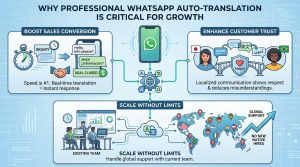
In overseas private domain operations, cross-language communication is a crucial bridge connecting global users. Different languages, cultures, and expression habits often lead to business understanding biases. Examples include misunderstandings of product functions, misaligned needs, or after-sales disputes. These biases affect conversion rates and user trust.
The rapid development of AI translation technology provides an efficient solution to this challenge. Through real-time, multilingual processing and contextual analysis, AI can significantly reduce communication errors. It improves service efficiency and business accuracy. Industry practice shows that a customer service system using AI translation can reduce the cross-language misunderstanding rate by more than 30%. It also helps improve private domain conversion rates. This article systematically explores the role of AI translation in reducing business understanding biases. It provides practical guidance for overseas companies.
I. Business Understanding Biases in Cross-Language Communication
Customer service dialogues for overseas companies often involve English, Spanish, Arabic, and Southeast Asian languages. The biases mainly stem from three sources:
- Literal Translation Biases: Ignoring context leads to the loss of professional terminology or implied meanings.
- Cultural and Contextual Differences: High-context cultures (such as parts of Asia) prefer indirect expression. Low-context cultures (such as those in Europe and America) seek directness and clarity. This easily leads to misunderstandings.
- Real-Time Communication Barriers: Time zone differences and multiple channels (WhatsApp, TikTok, Instagram) result in slow human translation responses. This amplifies problems.
These biases can lead to order cancellations, negative reviews, or lost repeat purchases. Traditional human translation is accurate, but costly and lacks scalability. It fails to meet the demands of high-concurrency private domains. AI translation uses neural machine translation (NMT) and large language models. It achieves real-time processing and significantly mitigates these problems.
II. Core Mechanisms of AI Translation
Modern AI translation has surpassed early rule-based or statistical models. It relies on deep learning and contextual awareness capabilities. The main mechanisms include:
1. Context and Semantic Understanding
AI models (such as those based on the Transformer architecture) can analyze dialogue context, user history, and business scenarios. This avoids isolated literal translation. For example, in product consultations, AI can recognize that “upgraded version” refers to a specific feature iteration. It does not interpret the phrase in a general way.
2. Real-time Multilingual Translation
AI supports 50+ languages (including dialect variations). It integrates into the customer service platform. It enables automatic detection and translation of user input. Customer service personnel do not need to be multilingual to respond fluently. This reduces response time to the second level.
3. Cultural Sensitivity Assistance
Advanced AI provides cultural hints or localization adjustments. This reduces biases in metaphors, idioms, or etiquette. For example, in high-context cultural dialogues, AI can supplement background explanations. This helps customer service grasp the user’s true intentions.
4. Domain-Specific Training
Fine-tune the model using enterprise-specific corpora. These include product knowledge bases and historical dialogues. This improves accuracy in industry terminology and brand language. It reduces business bias.
These mechanisms shift translation from “post-correction” to “preventative assurance.” They build a more reliable communication link.
III. Application Strategies in Overseas Private Domain Customer Service
When building a high-conversion cross-language customer service system, a hybrid model is recommended: “AI-led + human oversight.”
1. Tool Integration and Platform Selection
Prioritize customer service platforms that support AI translation. Examples include Zendesk (integrating DeepL and OpenAI) and Intercom (Fin AI assistant). Core functions should include:
- Automatic language detection and real-time mutual translation.
- Multilingual preset FAQs for the chatbot.
- Conversation summarization and sentiment analysis (to help identify potential biases).
2. Knowledge Base and Terminology Building
Establish a multilingual knowledge base. Include product terminology, frequently asked questions, and culturally appropriate phrases. AI continuously learns from historical dialogues. This improves translation consistency. Regularly conduct human review of high-risk content (such as contract terms and complaint handling). This ensures accuracy.
3. Tiered Processing Flow
- Routine Inquiries: Prioritize processing with AI chatbots or real-time translation. This covers over 80% of simple scenarios.
- Complex or sensitive dialogues: AI assists in generating draft responses. Human review ensures cultural nuance and business logic consistency.
- Upgraded scenarios: Introduce localized customer service or professional translators.
4. Data Closed-Loop Optimization
Record dialogue results after translation. Analyze deviation cases (such as order cancellations due to misunderstandings). Use feedback to train the AI model. Combine with a debriefing mechanism. Extract insights for product iteration or marketing adjustments.
IV. Practical Optimization Techniques
- Hybrid Human-Machine Collaboration: AI handles scale and speed. Humans ensure tone, emotion, and cultural fit. High-risk content (legal or brand image communication) must be manually reviewed.
- A/B Testing and Monitoring: Test different translation models or script versions. Track key metrics: translation accuracy, NPS, conversion rate, and upgrade rate due to misunderstandings.
- Overseas Scenario Adaptation: Train with localized corpora for major markets (Europe, America, Southeast Asia, Middle East). Identify dialects or cultural metaphors. Anonymize dialogue data in accordance with GDPR and other compliance requirements.
- Performance Incentives: Incorporate translation quality into customer service KPIs. Encourage team feedback on AI shortcomings. Drive model iteration.
Industry case studies: One cross-border e-commerce platform improved multilingual response accuracy to over 90% through real-time AI translation and localization training. It significantly reduced complaints and increased repurchase rates. Another platform used a hybrid model. It reduced support costs by 35% during peak periods while maintaining high customer satisfaction.
V. Potential Limitations and Risk Mitigation
Despite the significant effectiveness of AI translation, limitations remain:
- Cultural and Emotional Nuance Deficiencies: Idioms, humor, or subtle nuances may be lost. This leads to implicit biases.
- Professional Domain Challenges: Highly technical or legal content requires caution. Avoid misleading readers.
- Cumulative Bias Risk: If the base model training data is biased, cultural stereotypes may be amplified.
Mitigation strategies:
- Implement rigorous human-machine hybrid review.
- Conduct regular quality audits.
- Establish a company-specific terminology database.
- Use emotion recognition tools to proactively warn of potential misunderstandings.
Do not rely entirely on AI. This is especially important in high-value or crisis scenarios.
Conclusion
AI translation is transforming cross-language communication from an obstacle into a competitive advantage. Through contextual understanding, real-time processing, and continuous optimization, it effectively reduces misunderstandings. It helps overseas private domain operations achieve efficient and inclusive user service. It reduces costs and improves response speed. It also provides a solid foundation for global expansion.
Overseas companies should launch AI translation pilot programs based on their business scale and target markets. Gradually build an intelligent cross-language customer service system. Iterate and improve in practice. Only by combining technology with humanistic insights can misunderstandings be minimized and the long-term value of private domains be unlocked.
We recommend immediately assessing the translation capabilities of your existing customer service platform. Or consult a professional overseas service agency to accelerate implementation. If you encounter challenges in AI tool selection, corpus training, or handling specific misunderstanding cases, please share your experiences in the comments section. Or contact us for customized guidance. Accurate cross-language communication will become the core engine of your global business growth.