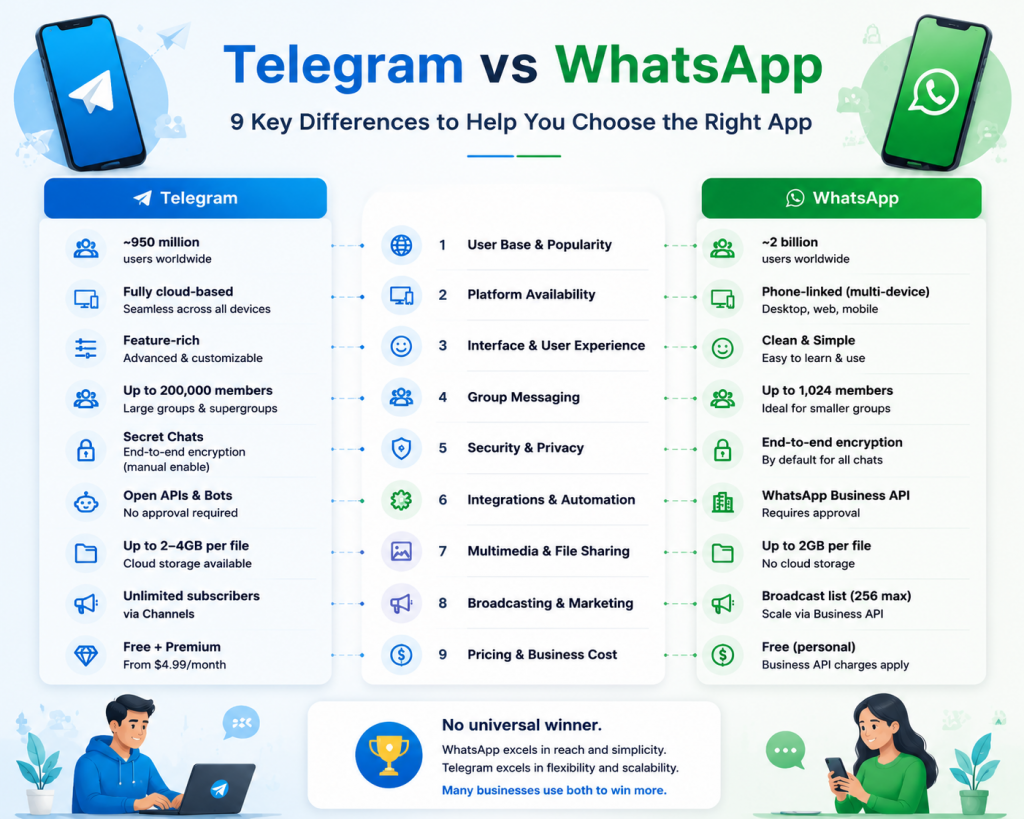
Messaging apps are now essential infrastructure for modern communication, especially for sales, marketing, and customer support teams. Two platforms dominate this space: Telegram and WhatsApp.
At first glance, they look similar. But once you go deeper, their differences significantly affect how businesses operate, scale, and engage customers.
This article reconstructs a clear, structured comparison based on key functional differences between the two platforms.
Quick Overview
| Feature | Telegram | |
|---|---|---|
| User Base | ~950M | ~2B |
| Group Size | Up to 200,000 | Up to 1,024 |
| Encryption | Secret chats only | Default end-to-end |
| File Sharing | Up to 2–4GB | Up to 2GB |
| Cloud Support | Yes | Limited |
| Broadcast | Unlimited | Limited / API-based |
| Integrations | Open bots & APIs | Business API (approved) |
| Ease of Use | Advanced | Simple |
| Pricing | Free + Premium | Free + Business API costs |
9 Key Differences Between Telegram and WhatsApp
1. User Base & Global Reach
WhatsApp dominates global adoption with over 2 billion users, making it the default messaging app in many regions such as India, Latin America, and Europe.
Telegram, while smaller (~950 million users), is growing rapidly and is especially popular among tech-savvy users in Asia, Eastern Europe, and the Middle East.
Key insight:
If your goal is mass reach → WhatsApp wins.
If your audience is niche or tech-oriented → Telegram is strong.
2. Platform Availability & Multi-Device Use
Telegram is fully cloud-based, allowing seamless multi-device usage without relying on a phone connection.
WhatsApp also supports desktop and web, but historically required phone linkage and still feels more constrained.
Key insight:
Telegram is better for teams working across multiple devices.
3. User Experience & Learning Curve
WhatsApp is designed for simplicity—clean UI, fast onboarding, and minimal setup.
Telegram offers far more customization and features, but this comes with a steeper learning curve.
Key insight:
WhatsApp = easy and intuitive
Telegram = powerful but complex
4. Group Messaging & Community Scale
Telegram supports massive groups of up to 200,000 members with advanced admin tools.
WhatsApp limits groups to around 1,024 participants, making it better for smaller communities or teams.
Key insight:
Telegram is built for large-scale communities.
WhatsApp is better for tight, controlled groups.
5. Security & Privacy Model
WhatsApp provides default end-to-end encryption for all chats, making security simple and consistent.
Telegram uses cloud-based messaging with encryption only in “Secret Chats,” requiring manual activation.
Key insight:
WhatsApp prioritizes simplicity in security.
Telegram offers flexibility but requires user configuration.
6. Integrations & Automation
Telegram provides open APIs and bot frameworks with no approval barriers, making automation easy.
WhatsApp integrations rely on the WhatsApp Business API, which requires approval and is more structured.
Key insight:
Telegram is more developer-friendly and flexible.
WhatsApp is more controlled but enterprise-ready.
7. Multimedia & File Sharing
Telegram supports large file sharing up to 2–4GB and offers cloud storage for easy access across devices.
WhatsApp also supports up to 2GB, but lacks true cloud storage functionality.
Key insight:
Telegram is better for heavy media workflows and content distribution.
8. Broadcasting & Marketing Reach
Telegram channels support unlimited subscribers, making it ideal for broadcasting content at scale.
WhatsApp has strict broadcast limitations unless using the Business API, which introduces costs and compliance requirements.
Key insight:
Telegram is stronger for mass broadcasting.
WhatsApp is better for targeted, high-intent messaging.
9. Pricing & Business Cost
Both apps are free for basic use.
Telegram offers a premium subscription with added features like larger uploads and faster downloads.
WhatsApp remains free for personal use, but business-level automation via API can introduce messaging costs.
Key insight:
Telegram is more cost-flexible for scaling.
WhatsApp may incur costs at enterprise level.
Which One Should You Choose?
The choice between Telegram and WhatsApp depends on your goals:
- Choose WhatsApp if:
- You need global reach
- You prioritize simplicity
- You rely on direct 1-to-1 customer communication
- Choose Telegram if:
- You need large communities
- You want automation and bots
- You distribute content at scale
Final Verdict
There is no universal winner.
WhatsApp dominates in reach and simplicity.
Telegram dominates in flexibility and scalability.
In practice, many businesses end up using both—WhatsApp for conversion, Telegram for community and distribution.