The news of the SCRM giant 007 exiting the market sparked discussions in many industry groups.
As someone who has long focused on private domain operations and overseas growth, my biggest feeling upon seeing this news was not surprise, but reflection.
Over the years, we have seen many tools rise and many platforms leave the market.
Every industry change prompts enterprises to re-evaluate their operational systems.
This time, I found more and more people beginning to ponder the same question:
If the platform they are using changes one day, what are enterprises truly worried about?
Is it troublesome to switch software?
It seems not.
For many enterprises, the bigger concern is:
- Can they still continuously reach customers?
- Can they still view historical communication records?
- Will the team’s operational processes be interrupted?
- Can they still communicate efficiently with overseas customers?
- How to manage customer resources accumulated across multiple platforms?
Ultimately, enterprises have never been worried about the tools themselves.
But rather the customer relationships and assets accumulated over the years.
Previously, Tool Selection Was About Features; Now, It’s About Capabilities
A few years ago, when enterprises chose SCRM or customer management tools, they focused most on features.
Is there an auto-reply feature?
Can messages be sent in bulk?
Can tags be added?
Can data be analyzed?
At that stage, everyone was comparing who had more features.
But in recent years, things have clearly changed.
As private domain operations mature, more and more enterprises are discovering:
Features are becoming increasingly homogenized.
The real differentiator is the operational capability behind the platform.
Especially for overseas teams.
Customers are no longer concentrated on a single channel.
They might be on:
- Telegram
- Messenger
Even the same customer may interact with the enterprise on multiple platforms.
At this point, the issue enterprises face is no longer customer management.
But customer operations.
After Going Overseas, I Found the Biggest Cost Is Actually Communication Cost
Many people think the hardest part of going overseas is acquiring customers.
But after interacting with more and more teams, I found:
Many orders are not lost due to traffic.
But due to communication.
Customers send messages in Russian.
Customer service copies it to a translation software.
Translates and then replies.
Customers send voice messages.
Customer service converts it to text.
Translates again.
Replies again.
Repeats hundreds of times a day.
Low efficiency is one aspect.
More importantly, it is easy to miss business opportunities.
Overseas customers often have less patience than we imagine.
If the reply is a few minutes late, the customer may have already contacted the next supplier.
Therefore, how to improve communication efficiency has gradually become one of the core issues for many overseas teams.
Why Are More Teams Focusing on Social Media Aggregation Platforms?
It is also in this process that I found more teams starting to adjust their tool stack.
Previously it was:
One platform for managing customers.
One platform for translation.
One platform for mass messaging.
One platform for data management.
Switching back and forth between different software every day.
Now more people hope:
All customer communications can be handled centrally.
All messages can be viewed in a unified manner.
All channels can operate collaboratively.
The reason is simple.
Customers will not communicate according to the enterprise’s management habits.
They will only use their accustomed social platforms.
Enterprises can only proactively adapt.
HelloKPI Showed Me a New Direction
When I recently came across HelloKPI, my biggest impression was:
It is not like a traditional SCRM.
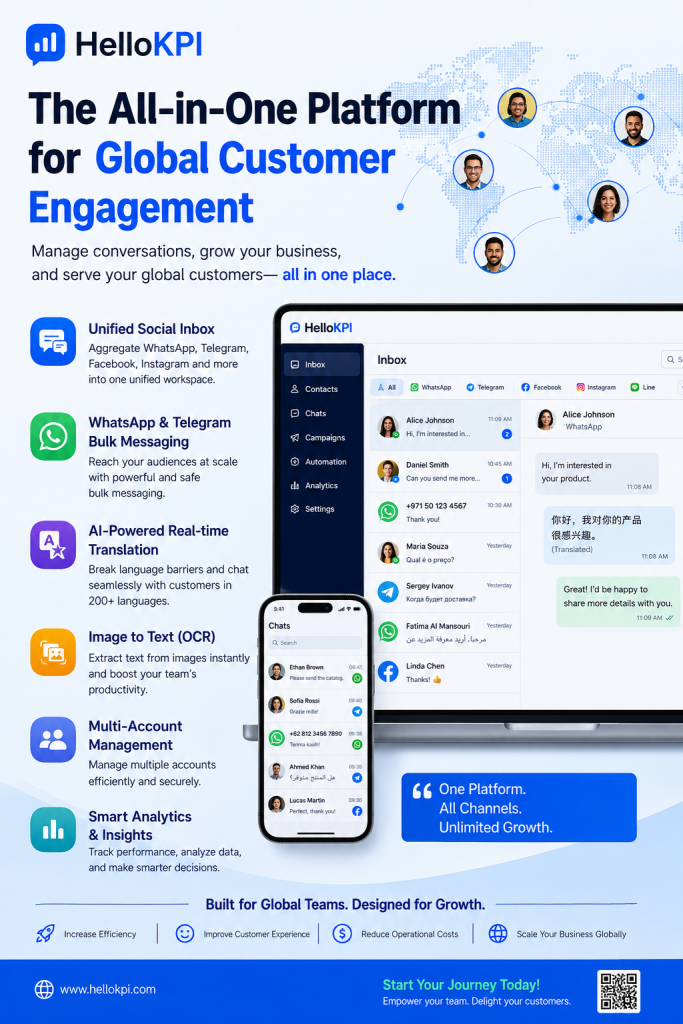
More like a workstation for global customer operations.
Aggregating Multiple Social Platforms
For overseas teams.
One of the biggest pain points is account dispersion.
WhatsApp has one backend.
Telegram has another backend.
Facebook has yet another backend.
Customer service switches windows every day.
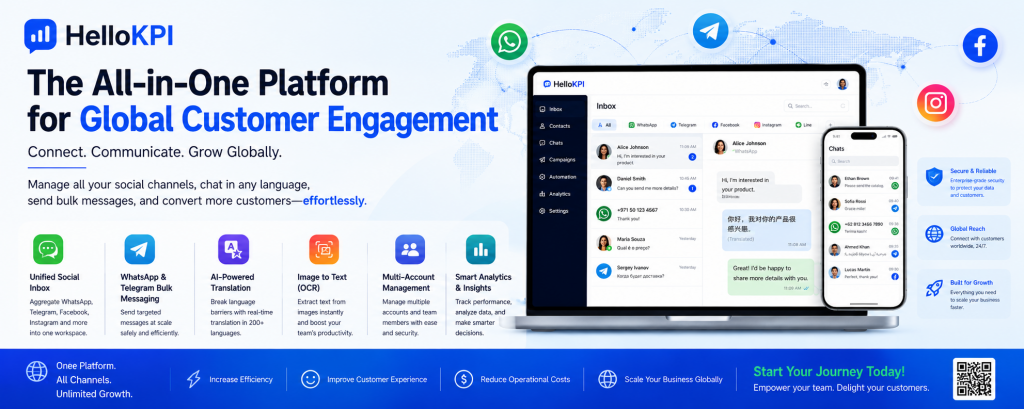
HelloKPI unifies multiple social media channels.
All messages are viewed centrally.
Unified replies.
For customer service and sales teams, this improvement in experience is very noticeable.
WhatsApp and Telegram Mass Messaging
Many enterprises understand mass messaging as marketing.
But in reality, it is more like a part of customer operations.
New product notifications.
Event promotions.
Old customer recalls.
Community operations.
All need to efficiently reach customers.
When the number of customers reaches thousands or even tens of thousands.
A stable mass messaging capability becomes very important.
AI Real-time Translation
This is one of the features that impressed me the most.
For those engaged in overseas business.
Language is always a barrier.
Customers send messages in Russian, Arabic, Portuguese.
The system automatically translates.
Customer service directly views the content in Chinese.
After replying, it automatically converts to the customer’s language.
The whole process almost requires no tool switching.
Communication efficiency is significantly improved.
Image Text Recognition
Many overseas customers like to send screenshots directly.
Payment screenshots.
Logistics information.
Product images.
Event posters.
Previously, content extraction was manual.
Now, through image text recognition and translation capabilities, key information can be directly obtained.
Although it seems like a small feature.
Its usage frequency in daily operations is very high.
The Industry Is Changing
007 exiting the market is just a microcosm of industry changes.
It makes more and more enterprises realize:
The focus of future competition is no longer just about features.
But whether enterprises can continuously manage customer relationships.
Where the customers are.
Enterprises should appear there.
What language customers use.
Enterprises should be able to understand that language.
Which platforms customers are distributed on.
Enterprises should be able to manage those platforms.
These capabilities are becoming new competitive strengths.
In Conclusion
After interacting with many enterprises over the years, I increasingly agree with one perspective:
What truly determines enterprise growth has never been the tools themselves.
But whether the enterprise has the ability to continuously manage customer relationships.
Because tools will change.
Platforms will change.
The market will also change.
But customer relationships are always the most important asset for enterprises.
And what enterprises need in the future is no longer just a simple management system.
But a set of operational systems that can connect, serve, and operate customers, and continuously accumulate customer assets.
This may also be why more teams are beginning to re-evaluate their tool choices and focus on global customer operation platforms like HelloKPI.